|
First time ever on CD with updated liner notes.
Oscar nominated - "Best Score."
Musicals, particularly original screen musicals created with children in mind, often have a hard time finding an audience: kids and their parents, it seems, would rather see a film in which the characters do not reveal their inner feelings in songs.
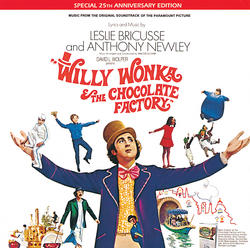
Throughout the years, however, there have been happy exceptions to the rule, with some films becoming true screen classics in the process, like Mary Poppins, Chitty Chitty Bang Bang, and the scrumdidilyumstious charming fantasy, Willy Wonka and the Chocolate Factory, released in 1971. Based on the children’s book, Charlie and the Chocolate Factory, by Roald Dahl, the film, which was entirely shot in strikingly beautiful Bavaria, starred Gene Wilder as an eccentric candymaker with a magic touch who turns a little boy’s dreams into reality.
Loosely structured, the plot hinged on a clever merchandising gimmick devised by the candymaker, who puts five golden tickets inside a candy bar run and invites the winners to his chocolate factory. There they meet Wonka and his friends, Mike Teevee, Augustus Gloop, Veruca Salt, Violet Beauregarde, as well as a lot of delicious Oompa-Loompas.
But, as is soon made clear, Willy Wonka has some very specific ideas in mind and is not altogether as altruistic as he initially seemed to be: unbeknownst of his visitors, he has set up some traps along the way to test their fundamental honesty. One after the other, the winners of the contest reveal the true, often unflattering side of their personalities, with somewhat unpredictable results. The only one who passes the exacting test is Charlie (Peter Ostrum), who is accompanied on the visit by his grandpa Joe (Jack Albertson), and who, as a result of his integrity, is ultimately rewarded by Wonka in a way he had not anticipated when he first came to the chocolate factory.
To bring this delightful story to screen life, producers Stan Margulies and David L. Wolper asked Leslie Bricusse and Anthony Newley to write the score. Their decision could not have been more fortuitous: together Bricusse and Newley had previously created two very successful, unusual musical fantasies for Broadway, Stop The World I Want To Get Off, in 1964, and The Roar Of The Greasepaint – The Smell Of The Crowd, the following year. Both shows had yielded huge hits in “What Kind Of Fool Am I?,” “Who Can I Turn To (When Nobody Needs Me),” and “The Joker,” in addition to other popular songs like “Nothing Can Stop Me Now,” “Gonna Build A Mountain,” and “On A Beautiful Day Like Today.”
Dahl’s screenplay inspired Bricusse and Newley to write a score teeming with many great tunes that closely matched the whimsical tone of the story, among which “The Candy Man” and “Pure Imagination” quickly emerged as hits. Later that year, the Film Academy acknowledged the quality of their work when it nominated the score for a prestigious Oscar.

|