|
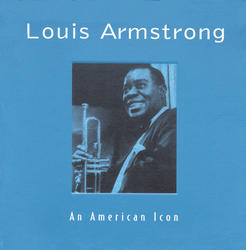
An American Icon compiles for the first time the most fruitful and popular era of Louis Armstrong's career 1946 - 1968 from his Decca, RCA-Victor, Verve, Columbia, Mercury, Roulette, & ABC recordings.
3 CD Set with over 3 1/2 hours of music.
52 page booklet written by Louis' producer George Avakian, detailed track annotations and rare photos.
_______________________________________________________________________
All the recordings in this collection are presented in chronological sequence, except for the first two tracks - a small shift, but it helps us start the story of Louis' career from the end of World War II in a clearer context - and a later section which places three major areas of his recordings into units which are more logical, both for listening and for following the course of Louis' professional life.
Like the Roman god Janus, our first song, "Do You Know What It Means To Miss New Orleans?" represents both past and future. Louis recorded it 24 years and 4 months after he had made his recording debut with King Oliver in 1923. In 1971, 24 years and 4 months after he had recorded “DYKWIMTMNO,” he would close his career by recording "The Night Before Christmas" in his own home.
“Do You Know What It Means" was the only enduring song from the 1946 film, "New Orleans" (in which Louis and Billie Holiday provided the only memorable moments), and it came to represent both a nostalgic look back at his Crescent City roots, and a harbinger of the future.
The presence of Kid Ory, both in the movie and this recording which opens our collection, reminds us that in 1917 he was the first New Orleans bandleader to hire young Louis (age 16), and eight years later he became a mainstay of Pop's first recording group, the Armstrong Hot Five. Also present is guitarist Bud Scott, who was already in the King Oliver band when Louis joined up in Chicago in 1923. With them is Barney Bigard, the veteran clarinetist (also from New Orleans).
The classic New Orleans instrumentation of this band is a pre-echo of the Louis Armstrong All-Stars (of which Bigard was to become a charter number). As Ernie Anderson predicted, the All-Stars would be the key to a new and better professional life for Louis, which would also boost his popularity and recognition - already substantial - like the multiplying effect of a second-stage rocket. The recordings that follow will trace how it happened.
"Pennies From Heaven" offers the same duality as our opening track. Looking back, old-timers will remember that it was the title song of the 1936 Bing Crosby movie which was Louis' impressive Hollywood debut as a scene-stealer of rare acting skill as well as musical aplomb. Louis' films would bring his likeness and personality to millions of new fans around the world. As for the future, this recording is from the 1947 Town Hall concert which inspired his manager to phase out Louis' 16-piece band and launch the All-Stars, whose debut at Billy Berg's small club in Hollywood on August 13 of that year started something which even Old Man Time will never be able to stop.

|